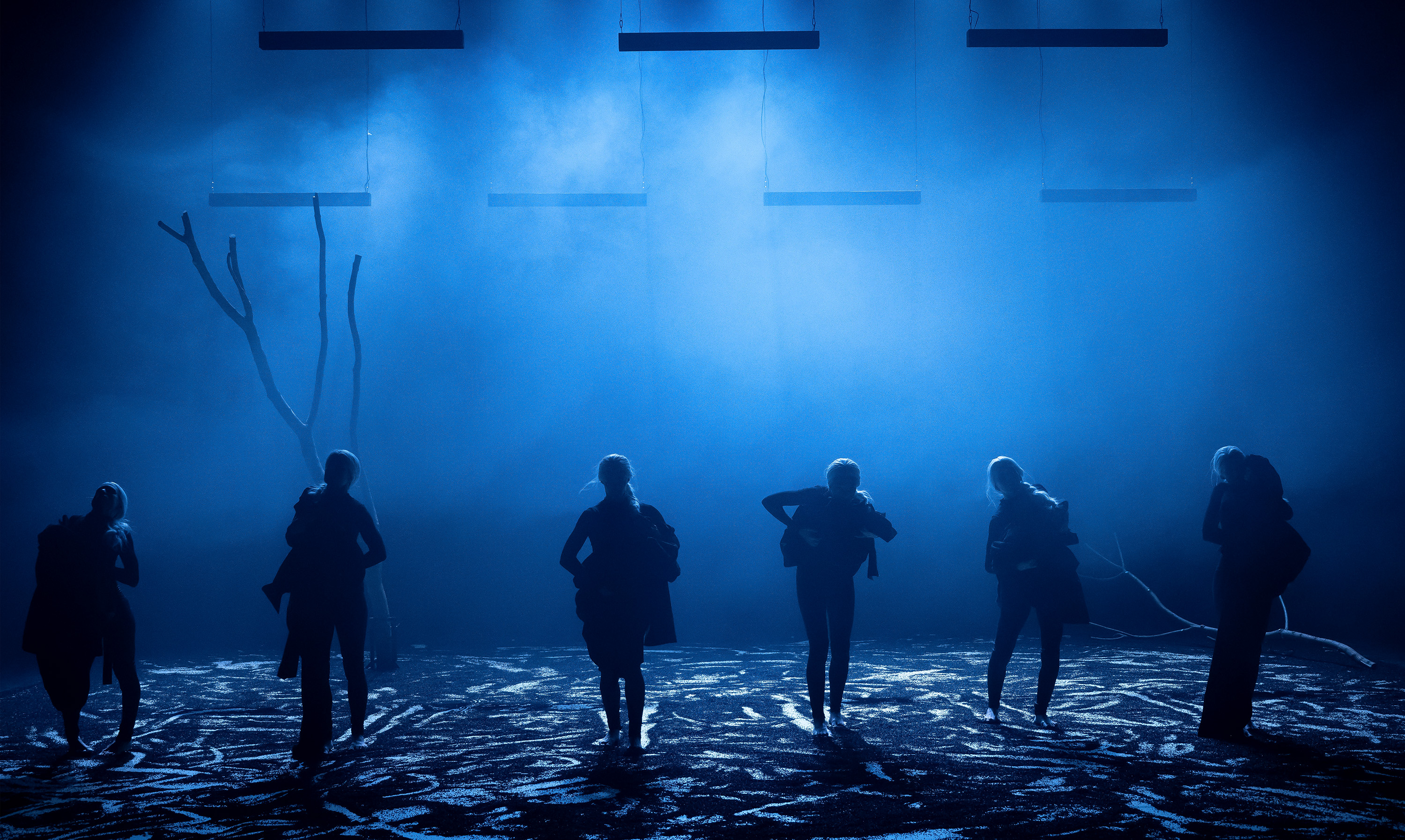
Life in Beta

Life in Beta

Choreography: Sofija Milić
Mentorship: Maša Kolar
Performed by: Mina Ugrin, Iva Matošević, Freya Farnlof, Julia Ekvold, Helen Tamasko, Janka Komuves, Vlad Furtuna, Anastasia Preotu, Mariia Kalashnikova, Yuliia Brazhnik
Music: Ognjen Šušić
Costume Design: Karlo Blažina
Visuals: Tihomir Filipec
Photo & video: Nina Đurđević

Premiere: 25/2/2026

This performance is created within the framework of the dancEUA project, co-funded by the European Union through the Creative Europe programme.
The project is implemented by the following organisations: Studio za suvremeni ples (HR), Central Europe Dance Theatre (HU), M Studio (RO), Vitlycke – CPA (SE) and Ukrainian Contemporary Dance Platform (UA).

In collaboration: Zagrebački plesni centar (ZPC) and TALA PLE(j)S.

Financially supported by: European Union, Ministry of Culture and Media of the Republic of Croatia, City of Zagreb, and Kultura Nova Foundation.


ABOUT

Life in Beta explores a world driven by optimization, abundance, and the pursuit of collective perfection. Set within a living board game, the work introduces ten avatars, each a node in a larger system governed by Beth, a central consciousness that harmonizes instinct and behavior for the good of the whole.

The system promises unity and the end of suffering, yet dissolves individuality in the process. No impulse is truly one’s own; choice becomes simulation, and abundance produces hyperreality rather than fulfilment. Though the structure implies competition – there is always one winner – the concept of winning collapses when everyone is endlessly improved.

Life in Beta critiques late-stage capitalism’s fixation on optimization and growth, asking what disappears when perfection is achieved, and whether abundance can exist without the loss of self.


Mica /ˈmʌɪkə/

Choreography: Astrid Boons
Performance: Marta Krešić, Filipa Bavčević, Nastasja Štefanić Kralj, Viktoria Bubalo, Ema Crnić, Dora Pocedić
Assistant choreography: Karolina Szymura
Costume and set design: Zdravka Ivandija Kirigin
Assistant costume and set design: Ana Roko
Music: Miguelángel Clerc Parada
Light design: Tomislav Maglečić
Visuals: Tihomir Filipec
Photography: Nina Đurđević and Inia Herenčić
Video: Matija Kralj Štefanić
Trailer: Ante Cvitanović

Artistic direction of Studio: Martina Tomić
Producer: Ivan Mrdjen
Production assistant: Jelena Ružić
PR: Ivana Sansević
Production: Studio for contemporary dance
Financially supported by: Ministry of Culture and Media of the Republic of Croatia, City of Zagreb, Kultura nova Foundation
Co-production: Zagreb Youth Theatre
Thanks to: Zadar Dance Ensemble

Premiere: 22.12.2025.


ABOUT THE SHOW

Mica /ˈmʌɪkə/ arises in a landscape of pressure, where traces of life persist in eroded materials and forms – an environment of resistance where transformation becomes the urgency of survival. The work takes its name from a group of metamorphic minerals composed of countless thin, flexible layers, each one a record of compression and endurance. Formed through heat and instability, mica bends, folds, and reflects, retaining the traces of its formation.

In this new work, Astrid Boons – known  for her emotionally resonant and deeply embodied performances – opens a space to reflect on what it means to live, change, and evolve together. Drawing from the structures and tensions of contemporary society, Mica traces the fragile balance between connection and isolation, the longing to belong. Bodies become vessels, each carrying echoes of others, shaped by shared memory and future possibility.

The choreography approaches this condition as a way of thinking about the body’s relation to change. In a time of social and ecological instability, it asks what versions of the future might emerge if we stay with the pressures that form us, allowing the body to search for forms of adaptation rather than alienation.

Mica imagines bodies that respond like minerals – accumulating, refracting, layering histories. Within fracture, reflection multiplies. The future is not a horizon ahead but a pulse within the multiplicity of time itself: an environment that carries memory as a living presence, where bodies discover new ways of survival.

ALL’ARME

Choreography: Ginevra Panzetti and Enrico Ticconi

Dancers: Martina Tomić, Ida Jolić/Ema Crnić, Viktoria Bubalo, Marta Krešić, Filipa Bavčević, Nastasja Štefanić-Kralj

Costumes: Tina Spahija

Music: Hrvoje Nikšić

Light: Tomislav Maglečić

Producer: Ivan Mrdjen

Public relations: Ivana Sansević

Visuals: Tihomir Filipec

Photo: Nina Đurđević

Produced by: Studio za suvremeni ples (SSP) – Studio Contemporary Dance Company

Financial support by: Republic of Croatia Ministry of Culture and Media, City of Zagreb, Zaklada Kultura nova, Instituto Italiano di Cultura di Zagabria

Coproduced in collaboration with the Pan – Adria network (ArtistiAssociati – Centro di Produzione teatrale, Gorizia; Zavod En–Knap, Ljubljana; Hrvatski kulturni dom na Sušaku, Rijeka; Zavod Flota, Murska Sobota via Ljubljana; Zagrebački plesni centar, Zagreb; Slovensko narodno gledališče Nova Gorica, Nova Gorica; Mediteranski plesni centar Svetvinčenat, Svetvinčenat)

Supported by Lavanderia a Vapore/ Fondazione Piemonte dal Vivo, in the frame of the residency program Lavanderia a Vapore, Collegno (TO), Kulturni centar Travno

Thanks: Zadar Dance Ensemble

Programme booklet (pdf)


ABOUT THE PERFORMANCE

The word alarm finds its origin in the Italian expression “all’arme!”, meaning “to arms!” or “to the weapons!” – a cry of warning historically used to incite readiness and defence in the face of imminent danger, such as an attack or invasion. “Arme” is the archaic form of “armi,” referring to instruments of defence or offence.

This etymology reveals that the concept of alarm is deeply intertwined with the act of preparing for battle, being ever vigilant and ready to defend oneself or respond to a threat. Over time, however, the meaning of “alarm” has evolved beyond its martial roots to encompass warnings of danger in a broader sense, extending to various situations of emergency.

Yet, as alarm prompts defence, it also raises questions: When does defence become aggression? How can we balance the need for protection with the risk of becoming a threat ourselves?

In this choreographic work for six dancers, Panzetti / Ticconi embark on a journey that begins with the rhythmic potential of the human step, exploring the persuasive power of synchronised and collective movement. Drawing inspiration from the military choreographic vocabulary, they delve into the tension between individual agency and collective force, questioning the fine line between necessary defence and the possibility of becoming what we fear.


FIREBIRD

CHOREOGRAPHY
Sergiu Matis

PERFORMED BY
Ana Mrak, Ana Vnučec, Martina Tomić,
Ida Jolić and Branko Banković

DRAMATURGY
Mila Pavičević

ASSISTANT OF CHOREOGRAPHY AND DRAMATURGY
Dina Ekštajn

TEXT
Sergiu Matis in colllaboration with the creative team and performers of Firebird

MUSIC
Hrvoje Nikšić

VOCAL COACH
Bojan Pogrmilović

LIGHT DESIGN
Saša Fistrić

COSTUME DESIGN
Zdravka Ivandija Kirigin

ASSISTANT TO COSTUME DESIGNER, MAKING OF HEAD PIECES
Ana Roko

MAKING OF SET PIECES
Leonardo Krakić, Krešimir Brkljačić, Antonio Gabelić i Dina Ekštajn

PHOTOGRAPHY AND VIDEO
Nina Đurđević, Anto Magzan

VISUALS
Tihomir Filipec

TRANSLATION OF SUBTITLES TO CROATIAN LANGUAGE
Ana Vnučec, Dina Ekštajn

PRODUCTION
Studio za suvremeni ples

PRODUCER
Ivan Mrđen

PREMIERE
13.10.2023. Zagreb Dance Center

Realized in cooperation wtih Zagreb Dance Center, as a part of non residential program support.
This project is supported by the funds of Croatian Ministry of Culture and Media, City of Zagreb and Kultura Nova foundation.
Thanks to: Helena Novosel, Matija Baotić, Hive.


ABOUT PERFORMANCE

How would the world look like without birds?
In this performance, the sad song of the firebird speaks about a world in flames. Dance becomes a desperate attempt of an escape from one’s own human form and transforms into a desire for metamorphosis and rebirth. In a world without future we reach for leftovers: myths and folk tales which are based on the force of nature. This search for the firebird forefronts birds which inspired folk storytelling. In times when many species are in danger of extinction, the firebird represents a hopeless gesture of nature conservation in theatre by recollecting imminent connection between human kind and environment.

ABOUT AUTHOR

Sergiu Matis


HOUSE BOLERO

CONCEPT AND CHOREOGRAPHY
Matej Kejžar

PERFORMED BY
Drago Asić Lika, Andrija Laboš Jerry, Desanka Virant, Bosiljka Vujović Mažuran, Branko Banković, Ana Mrak, Ana Vnučec, Martina Tomić, Ida Jolić, Šimun Stankov i Ana Novković

LIGHT DESIGN AND SCENOGRAPHY
Petra Veber

PHOTOGRAPHY
Nina Đurđević

PRODUCTION
Studio Contemporary Dance Company: Tena Bošnjaković, Ivan Mrđen

PREMIERE
November, 14th 2022. Zagrebačko kazalište mladih, Zagreb

Thanks to: Snježana Šolić, Damir Buntak, Igor Ekštajn, Milica Sinkauz, tehnika ZKM i tehnika HNK

This project is supported by the funds of Croatian Ministry of Culture and Media, City of Zagreb and Kultura Nova Foundation.


ABOUT
It all started as an ode to Dance five years ago, with a common experiment on how to learn from dance, rather than on learning how to dance or how to be oneself. The crazy, odd, queer and idiosyncratic dance styles evolved around working with (respecting) physical presence, and focused on kinesthetic writing in the matter of space and time, in an (under) common force-field, in a dynamic territory, and in a place where a constant change of dynamics is possible.

This time, the occasion is the 60th anniversary of the Studio Contemporary Dance Company. It is an intergenerational experiment with the dancers aged 21 to 69. Working with their bodies, with various ways of physical presence, and a passion for dance they inevitably bring about new implications: the writings of dances as a force that challenges the vast field of normalization.


Cockroaches

DIRECTED BY
Mario Kovač

CHOREOGRAPHY
Branko Banković

PERFORMED BY
Dina Ekštajn, Ana Mrak, Martina Tomić, Ida Jolić

MUSIC
Tomislav Babić

LIGHT DESIGN
Marino Frankola

ROBOTS CREATED BY
Vedran Relja

COSTUMES
Ana Mikulić

GRAPHIC DESIGN
Tihomir Filipec

DRAWING
Vitja Telalović

PHOTOGRAPHY
Nina Đurđević

PROMO VIDEO
Matija Kralj

PRODUCTION
Studio za suvremeni ples

This project is co-financed by: Croatian Ministry of Culture and Media, City of Zagreb and the Kultura Nova Foundation.


O PREDSTAVI
Stanislaw Witkiewicz wrote a short drama piece called Cockroaches when he was eight years old, inspired by Shakespear’s opus which he had just read. In it, through four scenes located on less then two pages of text, he achieves comic absurdity of child’s view of the world, but also grotesqueness comparable with later works of Ionesco and Harms. In that little drama piece, from the very beginning, there is a presence of the spirit of catastrophism, which has, in the pastfew years pandemically conquered our whole planet. Something undefined, big and grey is approaching a happy kingdom and endangers its existence and its habitants alternately pass through different emotions, not knowing how to react.

The new performance of Studio Contemporary Dance Company brings robots, science fiction and aestetics of video games on stage, all of it inspired by contemporary dance expression. The intention of the authors is to make a performance for children, which is adapted to this time and space, a performance which children can recognize as their own and in which adults can get a chance to peek into hidden corners of children’s imagination.

The performance is for everybody, from the age of 5 to 105!


figures, figures.

CHOREOGRAPHY
Martina Tomić

PERFORMED BY
Dina Ekštajn, Ida Jolić, Ana Mrak

DRAMATURGY
Ivana Đula

SOUND DESIGN
Luka Vrbanić, BILK

COSTUMES
Ana Fucijaš

LIGHT DESIGN
Toni Modrušan

TEXT AND GRAFIC DESIGN
OAZA (Nina Bačun and Roberta Bratović)

VISUAL
Lena Kramarić

PRODUCTION
Studio Contemporary Dance Company:Tena Bošnjaković, Ivan Mrđen

COPRODUCTION
Nonresidential program Zagreb dance centar

PREMIÈRE
Premiere 26.11.2021. Zagreb dance centar, Zagreb

Thanks to: Milica Sinkauz, Branko Banković, Ana Vnučec, Ana Kreitmeyer, Aleksandra Jurišić Rastović

The performance was financially supported by the Zagreb City office for culture, the Ministry of Culture and Media and Kultura Nova foundation


ABOUT PERFORMANCE

we seek inspiration for this dance epic from
an essay by giorgio agamben called the end of the poem
in the text it states that poetry emerges from the tension
between sound and meaning
the possibility of enjambment is what separates poetry
from prose: the moment when the rhyme ceases
to correspond with the end of a thought
but what happens when the poem ends, when
the possibility of enjambment ceases to exist,
is the end of a poem a crisis of the verse and
a negation of the poetic
when analyzing a baudelaire poem and its ending
proust notices how the poem is suddenly
ruined how it lost its breath
walter benjamin when speaking about the end of another baudelaire
poem says that the poem suddenly
ends itself as if a poem could not truly have
an end because an end presumes what
is not immanent to poetry: the correspondence of sound
and meaning
leaning on valéry’s observation that
poetry is to prose what dancing is to walking we transfer the obsession
at the end of the poem to movement
what is the end of movement, where does dance begin, when does
walking become dancing, what if the end
becomes the beginning
while seeking for the answer we stop the movement in poses
static figures
by investigating the notion of a figure in everyday life
literature sport dance we create landscapes
through bodies
(landscapes of figures in movement) we examine our relationship
towards (our own) figure, we push it outside of its borders
of previously established movements
we expose ourselves
how comfortable do we feel in a presumed female
figure, what is a presumed female figure, what if
we go too far, where is the boundary and is there one
a moving figure becomes dance, brings an array of new
associations and emotions, which of these do we find
acceptable, which of these we do we not, what do they mean for us
and should they mean something, what is a typical figure in
contemporary dance
we imagine the five books as a dedication to dance
to body,
to figure,
to (the) end.


Healers

CONCEPT AND CHOREOGRAPHY
Jasna Layes Vinovrški

PERFORMED BY
Ana Vnučec, Martina Tomić, Branko Banković

STAGE DESIGN
Clement Layes

COSTUMES
Malena Modeer

LIGHT DESIGN
Catalina Hernandez

CHOREOGRAPHIC ADVICE
Dina Ekštajn

PERFORMANCE ASSISTANCE
Mia Stark

PRODUCERS
Tena Bošnjaković, Ivan Mrđen/Valerie Terwei, Joseph Wegmann

PRODUCTION
Studio Contemporary Dance Company in coproduction with Public in Private

PREMIÈRE
July, 1st, 2021, Zagreb Dance Center, as a pert of the festival PERFORACIJE

Funded by Berlin Senatverwaltung for Culture and Europe, Croatian Ministry of Culture and Media, the City of Zagreb, Foundation Kultura Nova. Production by Cie Public in Private in coproduction with Studio Contemporary Dance Company from Zagreb and Tanzfabrik Berlin.


ABOUT PERFORMANCE

HEALERS is a co-production between Public in Private company from Berlin and Studio contemporary dance company from Zagreb. Initially two different “Healers” teams from Berlin and from Zagreb had to work together hand in hand on stage. Due to the corona crisis, the collaboration couldn’t take place as planned and the two teams will perform for now separately. However the work has been created and developed with both teams equally. Also the first draft of this work was made in close collaboration with Darko Dragičević, during the event series Flutgraben performances #1 in 2019.

Artistic team of Healers has the task of discovering and eliminating situations, unsolved problems, emotional and energetic stagnations which could have accumulated in the walls of the space in which the performance is happening.

In this choreographic endeavor, by combining fiction with historical-documentary elements, the ground for subtle humor is being created, that is an artistic gesture with which the desire for different visions and imaginations of the world we live in is called upon.

ABOUT AUTHOR
Jasna L. Vinovrški grew up in Zagreb, Croatia, but has lived and worked abroad since the disintegration of Yugoslavia. In the early 90s she studied in Essen, at the Folkwang University of the Arts, and worked as a dancer and performer with various European choreographers (Groupe Dunes, J. Schömer, C. Sagna, O. Duboc among others) after graduating. During that period she created her first shorter choreographies, including the solo work „Which Club?“, which has won several awards. After moving to Berlin in 2008 with her partner Clément Layes, she co-founded the company Public in Private where the two artists continue developing separate choreographic signatures while closely supporting each other artistically. In 2012, Jasna received her MA in Choreography at the Inter-U University Center for Dance (HZT) in Berlin. Her recent work „Staying Alive“ has been touring all over Europe and was also presented in New York, US, in 2017. www.jasnavinovrski.com


Fantastic Species

CHOREOGRAPHY
Ana Kreitmeyer

PERFORMED BY
Branko Banković, Dina Ekštajn, Ida Jolić, Ana Mrak, Martina Tomić, Ana Vnučec

DRAMATURGY
Nina Gojić

SOUND DESIGN
Nika Pećarina

COSTUMES
Dalibor Šakić

SET AND LIGHT DESIGN
Igor Pauška

ASSISTANT DRAMATURG
Vida Zelić

PRODUCERS
Tena Bošnjaković, Ivan Mrđen

PRODUCTION
Studio Contemporary Dance Company

PREMIÈRE
Premiere 24.05.2021. Museum of Contemporary Art, Zagreb

Thanks to: Croatian Environmental Protection Agency, Dobrila Zorić, Bernarda Cesar, The School of Applied Arts and Design, Marjan Maragunić, Zrinka Užbinec, Nikolina Pristaš, Tomislav Žilić, Zagreb Youth Theatre’s technical department.

The performance was financially supported by the Zagreb City office for culture, the Ministry of Culture and Media and Kultura Nova foundation, and realised within the Museum of Contemporary Art’s programme Antisezona 21.


ABOUT PERFORMANCE

Fantastic species arrived in a space that wasn’t originally theirs and in it they’re trying to build a new potential habitat. They are one organism and many at once, their wing moves around its communal body that doesn’t fly, they walk on a goat’s leg with a vulture’s claw, they don’t have their head where the head should be but somewhere else, and soon enough they have two and six heads, they can be an ant and a lion at once, it can stick to other bodies, sometimes it’s a stone, and sometimes it’s not there at all.

As such, this being is always escaping: it escapes being a fixed image of itself, it escapes our knowledge about it. It is an outlaw that always finds its escape route, even when there seems to be none (Oxana Timofeeva). It chooses to stay with the trouble (Donna Haraway) and by always constituting new relations between its composite parts, it develops its collective intelligence and affirms mutual aid as the key principle of evolution. This being, an ecosystem in fact, is aware that when one of its constituents disappears, its whole disappears as well, which was only temporary anyway. That way it creates an eternally shifting environment which keeps negotiating its own conditions of habitability.

The fantasticality of dance vocabulary is drawn from Jorge Luis Borges’ Book of Imaginary Beings, especially from the being called Baldanders which is used as a note for the principle of movement:

“Baldanders (whose name we may translate as Soon-another or T-any-moment-something-else) was suggested to the master shoemaker Hans Sachs (1494 – 1576) of Nuremburg by that passage in the Odyssey in which Menelaus pursues the Egyptian god Proteus, who changes himself into a lion, a serpent, a panther, a huge wild boar, a tree, and flowing water. Some ninety years after Sachs’s death, Baldanders makes a new appearance in the last book of the picaresque-fantastic novel by Grimmelshausen, The Adventuresome Simplicissimus (1669). In the midst of a wood, the hero comes upon a stone statue that seems to him an idol from some old Germanic temple. He touches it and the statue tells him he is Baldanders and thereupon takes the forms of a man, of an oak tree, of a sow, of a fat sausage, of a field of clover, of dung, of a flower, of a blossoming branch, of mulberry bush, of a silk tapestry, of many other things and beings, and then, once more, of a man. He pretends to teach Simplicissimus the art “of conversing with things which by their nature are dumb, such as chairs and benches, pots and pans”.
Baldanders is a successive monster, a monster in time. The title page of the first edition of Gimmelshausen’s novel takes up the joke. It bears an engraving of a creature having a satyr’s head, a human torso, the unfolded wings of a bird, and a tail of a fish, and which, with a goat’s leg, and vulture’s claws, tramples of a heap of masks that stand for the succession of shapes he has taken. In his belt he carries a sword and in his hands an open book showing pictures of a crown, a sailing boat, a goblet, a tower, a child, a pair of dice, a fool’s cap with bells, and a piece of ordnance.”

(Jorge Louis Borges: Book of Imaginary Beings, London: Vintage Classics, 2014)

ABOUT AUTHOR

Ana Kreitmeyer She is a dance artist, performer, and a member of the performative collective BADco. She has executed her interest for the body through different practices, from performative to choreographic, from pedagogical to social. As a coauthor, she has been active within the collective BADco and since 2003, she has developed her own choreographic works. She is an advocate for the independent dance scene in Zagreb, has been a publicly active member of the Croatian Dancers Association for many years as well as the Association’s president since 2016. She is a certified teacher of ContaKids Method. She graduated from the Faculty of Education and Rehabilitation Sciences.


SPECTACLE

CHOREOGRAPHY
Irma Omerzo

PERFORMED BY
Ana Mrak, Ana Vnučec, Martina Tomić, Ida Jolić, Tea Maršanić

DRAMATURGY
Jasna Jasna Žmak

MUSIC
Stanislav Kovačić

COSTUMES
Zdravka Ivandija Kirigin

SCENOGRAPHY
Vanja Magić

CHOREOGRAPHY ASSISTANT
Dina Ekštajn

PHOTOGRAPHY AND VIDEO
Jasenko Rasol

PRODUCERS
Tena Bošnjaković, Ivan Mrđen

PRODUCTION
Studio Contemporary Dance Company

PREMIÈRE
Premiere 10.10.2020. High school yard Elipsa

The performance has been supported by the Zagreb City Office for Culture, Croatian Ministry of Culture and Media, and Foundation Kultura Nova


ABOUT PERFORMANCE

New performance by Studio Contemporary Dance Company ’SPECTACLE’, choreographed by Irma Omerzo, questions the heritage of this eldest Croatian contemporary dance company. However, instead of a classic hommage performance, the author approaches Studio’s tradition by using it for questioning conditions, meanings and reasons of collectiveness in present time, on stage and outside of it. By generating dance vocabulary from selected photographies of dance performances produced by Studio, specific dance experience of performers and massive ‘spectacular’ choreographies, in this work Omerzo questions perspectives of unison movement and the possibilities of its deconstruction while, at the same time, searching for boundaries, frames and combinations of collectiveness. The title of the performance is at the same time a reference to the fascination by unison movement in mainstream culture, but also a reminder of the potential which surfaces as a consequence of its persistence. ’SPECTACLE’ in this sense denies traditional protocols of spectacularity which insists on uniformity, replacing it with emphasis on the potential of being together in a way that affirms also individuality in this collectiveness.
Jasna Jasna Žmak

ABOUT AUTHOR

Irma Omerzo , choreographer, certified instructor of Feldenkrais method, teacher at Academy of Dramatic Art in Zagreb. She went through dance education in France, at Centre Nationale de Danse Contemporaine – Angers. She worked in France from 1991 till 2005 with Andy Degroat, and also in the DCA Company with Philippe Decoufle, where she was active for ten years as a dancer and choreography assistant. She also worked with director and choreographer François Verret. Additionally, she also completed her education in Feldenkrais method, in Paris, Accord Mobile, with the guidance of Myriam Pfeffer, who was an assistant to Mosha Feldenkrais, the inventor of the method. In 2001, she created an artistic organization called MARMOT in Zagreb. Irma is the author of internationally renowned dance performances: Mi-Nous, Meni ti to nije baš, Euro vizija, Kratki program br. 1, Foto-plession, Treći kratki program – Tri solistice, Odijelo ne čini čovjeka, Vizita, Ništa, Tehnika, Meteo, Do kosti, U hodu, Razlikovanja, te nekoliko plesnih filmova: Plesati sa…,Tri solistice, U našem gradu.
She is also the creator of short dance installations for non-theatre spaces, performances, dance related sociology researches, programming of dance movies, and collaborations with visual artists and performers. As a movement advisor in a number of theatre drama projects, she has been awarded several times. In 2011, she won the Award of Croatian Dancers Association for her work as a choreographer and teacher, for her commitment to improving the quality of the status of contemporary dance. Since 2013, Irma is a teacher in the Department of Dance at the Academy of Dramatic Arts, where she holds regular classes in choreography, Feldenkrais and performance workshops.


Conversation Pieces

CHOREOGRAPHY
Magdalena Reiter

PERFORMED BY
Ana Vnučec, Dina Ekštajn,
Martina Tomić, Ana Mrak,
Ida Jolić i Una Štalcar Furač

DRAMATURGY
Vedrana Klepica

MUSIC
Nenad i Alen Sinkauz

LIGHT DESIGN
Marino Frankola

COSTUME DESIGN
Ana Savić Gecan

STAGE DESIGN
Andrej Rutaj

CHOREOGRAPHY ASSISTANT
Lada Petrovski Ternovšek

PHOTOGRAPHY AND VIDEO
Neven Petrović

PUBLIC RELATIONS
Nina Kunek

PRODUCTION
Studio Contemporary Dance Company in coproduction with Mirabelka Productions and Zagreb Dance Center within its 2019. artist in residence program

ARTISTIC DIRECTOR
Bosiljka Vujović-Mažuran

PRODUCER
Branko Banković

PARTNERS
Zavod Bunker / Ljubljana, Dance Week Festival / HIPP

PREVIEW
Preview 04.06.2019. ZPC

PREMIÈRE
Premiere 05.06.2019. ZPC

The performance has been supported by the Zagreb City Office for Culture, Croatian Ministry of Culture and the City of Ljubljana


Conversation Pieces – trailer by Neven Petrovic on Vimeo.

ABOUT PERFORMANCE

Standing off to one side. Seeing only the world in fragments, there won’t be any other one. Moments, crumbs, fleeting configurations – no sooner have they come into existence than they fall to pieces. Life? There’s no such thing; I see lines, planes and bodies, and their transformations in time.
Olga Tokarczuk, Bieguni (Flight)

John Berger once said that the way we look at a piece of art is determined by a series of assumptions: about beauty, truth, civilisation, form, status, and taste.
With this in mind, the matter of modern dance seems even more volatile, evasive, incomprehensible, especially if it does not rely on description, on an imaginative framework to mould and shape the body, but on the body itself and its own possibilities of interpretation. This is why Magdalena Reiter calls her new performance Conversation Pieces. She does not rely on any predefined conversation subject – whether it takes place between the choreographer and the dancer or between the dancer and the audience. Her primary focus is on (female) bodies and their own monologues. Their exhaustion, limitations, spatial relations, one isolated body in a group of bodies as well as in space and time.
And even more importantly, the structure of her choreographic expression creates visual references to the perceptions of the female body that always evade clear interpretation. These references stem from the collective memory of the history of art, sculpture in particular, of the complexity and refinement of the body. Yet these references disintegrate all too quickly, before they develop. They provoke with their fluidity and unmet expectations about how a female body should move and behave on stage. Body is approached in a laboratory-like fashion. It’s all about anatomy, about the basic elements. A movement that at one moment seems sensual disintegrates into a skeleton, flesh, and skin. On stage, the bodies often move without one of the extremities, which is hidden or immobilised. The movement becomes funny and painful at the same time. Its flow saturated and blocked by repetitiveness. The cracks opening up through destruction, analysis, and redefinition of body as imperfect and unexpected provide a glimpse of criticism of how we perceive female body on stage, but also of self-perception, of self-awareness and the resulting behaviour. Through these cracks we are given the chance to change our understanding of the body as best as each of us can.
Vedrana Klepica

ABOUT AUTHOR

Magdalena Reiter is a Polish choreographer, dancer, and teacher, who works and lives in Slovenia. She graduated from the National School of Ballet in Gdansk, Poland, and the contemporary dance school Performing Arts Research and Training Studios. She choreographed over 15 shows in her own production or as commissioned pieces (for the Polish dance theatre Poznan Ballet, Bodhi Project SEAD dance ensemble, Anton Podbevšek Theatre, and Plesna Izba Maribor). She has received an international jury award for the best performance on the 2nd Slovene Dance Festival and an award for the best performance at the 8th Sarajevo Teaterfest. Her performances have been staged in several European countries. She choreographed a number of plays (with Mateja Koležnik, De Tijd, Janez Burger, Matjaž Berger, etc.) and opera productions (Flemish opera with Joachim Brackx, Flying Dutchman in Cankarjev Dom, Ljubljana, Slovenia) and collaborated as a movement consultant in films (Tiha sonata and VAN by Janez Burger).
Magdalena has performed in her own and other peoples’ choreographies and worked with other directors (Dada von Bzdülöw, Johanne Saunier, Mateja Bučar, Matjaž Farič, Matjaž Berger, etc.). She gives workshops and lectures, and mentors. She has taught in Slovenia, Austria (SEAD), France, Poland, Belgium and Croatia, to name a few places. Magdalena has also founded and has been the art director of VIBRA – The International Summer Dance Workshops in Ljubljana, as well as of Mirabelka Productions.


Study for Emergency Artist

CONCEPT
Clément Layes

PERFORMED BY
Dina Ekštajn,
Ana Vnučec,
Stevie Koglin / Šimun Stankov

LIGHT DESIGN
Bojan Gagić

COSTUME DESIGN
Ana Savić-Gecan

COSTUME DESIGN ASSISTANT
Ozana Gabriel

STAGE DESIGN
Jonas Maria Droste
Clément Layes

PRODUCTION
Studio Contemporary Dance Company in coproduction with Platforma HR and collaboration with Zagreb Youth Theatre and support of Cie Public in Private

ARTISTIC DIRECTOR
Bosiljka Vujović-Mažuran

PRODUCER
Branko Banković

PRODUCTION SUPPORT
Koraljka Begović

PREMIÈRE
25.05.2018. at Cultural centar Histrionski dom

SPECIAL THANKS TO
Toni Andrijanić, Bruno Fetze, Nina Violić, Studenti plesnog odsjeka ADU, generacija 2016 / 2018

The performance is funded by the Zagreb Office for Culture and  Ministry of Culture of Republic Croatia


ABOUT PERFORMANCE

Different in terms of expression and approach but similar to Ensemble in terms of subject matter, considering that it too is exploring the position of the artist in art production and market conditions, Clément Layes’ Emergency Artist focuses on the question of how to maintain the necessary sensibility and differentiate artistic impulse from imposed values when faced with the imperative to succeed, in a culture that does not tolerate mistakes and failures. How does society shape an artist if it does not let them learn and grow from their own mistakes? If an artist does not have the right to make a mistake or an experiment with an unknown result, does that make art uniform? What is the success of an art project measured with? Is art still art if an artist meets the requirements for a desirable art product? Can an artist in such circumstances develop a critical approach to their own work and to the society in which they create and which they are made by? Where is the artist’s responsibility in all of that? read more...

An artist for emergency interventions must therefore learn to cope with failure because failure makes them face their own range and efforts, leads them towards alternative options and offers them the possibility to be redefined. Art happens when we leave our comfort zone, in constant deconstruction and reconstruction, in minimal changes which generate a shift in meaning, a shift in overall perception. Supported by neutral manner of performance, the balance which has just been achieved is destabilised both on the language level and the physicality level by minor tone, intensity and dynamics modulations; i.e.one imbalance is balanced by another one. Images are multiplied by association and are mutually strengthened, and the initial artistic task becomes merely the starting point for the next one.

ABOUT AUTHOR

Clément Layes has been living and working as a choreographer and performer in Berlin since 2008. Here, he co-founded the company Public in Private together with Jasna L. Vinovrški. At the interface between choreography, the visual arts and philosophy, the point of his works is found in observations on daily life. His performances – among them “Allege” (2010), “Der grüne Stuhl” (2012), “Things that surround us” (2012), “dreamed apparatus” (2014), and “TITLE” (2015) – are shown internationally. In October 2017, Layes premiered “The Eternal Return” at Berlin’s Sophiensæle. The group piece is the first choreographic work of a new series, in which Layes deals with the manifestation and mechanics of rhythm.

Public in Private research, reflects and questions social, political and cultural structures, as well individual position in this structures. Public in Private goal in collaborative approach is to broaden up the borders of choreographic language, intriguing different thinking, perceiving and reflecting about own and about other medias. Most relevant aim is however, further developing of choreography as contemporary art form.
www.publicinprivate.com